Causes
Features of Inherited Cancers
Your doctor may look at your family's medical history to find out if cancer runs in your family. This means that it's hereditary. You may be asked the following questions:
-
Do you have a history of cancer?
-
How many people in your family have had cancer?
-
What type or types of cancer have your family members had?
-
Has anyone had more than one type of cancer?
-
What were their ages when the cancer started?
-
What sex are your family members with cancer?
-
Are the cancers unilateral or bilateral? This means, does the cancer affect just one side of the body or both? (For instance, cancer was found in both kidneys.)
-
What type of environmental exposures or lifestyle risks do the family members with cancer have that might be linked to their risk for cancer? For instance, do they smoke?
-
How are the people with cancer related to one another?
-
Is there a vertical pattern of inheritance? For instance, are there parents with cancer who have children with cancer?
-
What is the ancestry and ethnicity of your family?
This information is recorded in a form of a family tree called a pedigree. Many times, other information, like medical records or the results of genetic testing, are requested.
All this information is used to try to classify your family history into one of three categories. These include sporadic, familial, and inherited. These help to find out:
-
If your relatives have an increased chance of getting certain types of cancer.
-
How great the risk of cancer might be.
-
If genetic testing might help you learn more about cancer risks in your family.
Sporadic cancer
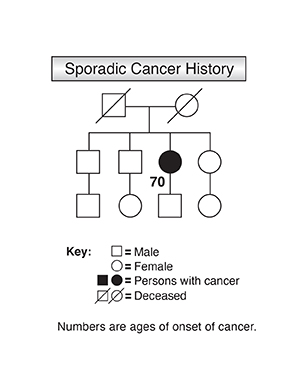
The word sporadic means to happen by chance. Most cancers are sporadic cancers. They're caused by gene changes that take place in one cell that, with time, are passed on to new cells and can lead to cancer.
Families who have few people with cancer at an older age are often classified as sporadic. In other words, there's no inherited pattern of cancer present. This may be the case if there are one or two people in your family who have cancer at a typical age of onset. Because cancer is common, this isn't abnormal.
With sporadic cancers, relatives are often at normal, but not increased, cancer risk. Genetic testing is often not helpful in these families.
Familial cancer
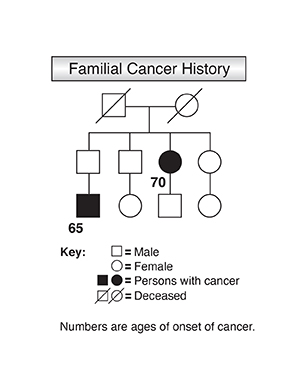
Familial cancer means that there are more people with cancer in your family than chance alone would predict. And these cancers often happen at a younger age than expected. This may mean there's a gene mutation passed on in your family that increases the risk for cancer. But it could also be a sign of shared environmental or lifestyle factors. For instance, if there seems to be a lot of lung cancer among older family members who smoke, the cause is more likely smoking than an inherited gene change.
In general, with familial cancer, close relatives have a modestly increased risk of developing the cancer in question. There's a small chance that genetic testing will help to further assess cancer risks.
Inherited cancer
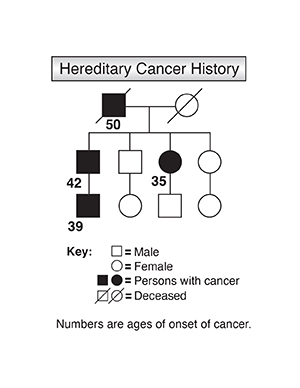
Inherited cancer (also called hereditary cancer syndrome) means that you have many family members with the same or related cancers. The cancers tend to happen at younger than average ages, often younger than age 50. These cancers are more likely to affect both organs of a pair, like cancer in both kidneys or in both breasts.
There's also often a history of family members who have had two or more kinds of cancer, such as ovarian cancer in a breast cancer survivor. Here are some facts about inherited cancer.
-
Inherited cancer is linked to a changed gene (gene mutation) that increases the risk of certain types of cancer. The mutation is found in every cell in the body. By itself, it doesn't cause cancer. But other random mutations added to it lead to cancer.
-
These cancers are rare. Fewer than 1 in every 100 people with cancer can link it to an inherited gene.
-
Families with inherited cancer often have cancer in two or more generations.
-
When a parent has an inherited gene mutation, each child has a 1 in 2 chance of inheriting it.
-
People in the family who inherit the mutated gene have a high chance of developing the cancer or cancers linked to it.
-
Those who don't inherit the mutated gene aren't at increased cancer risk.
Genetic testing isn't right for everyone. But it can often be helpful in figuring out who in the family has an increased cancer risk. In most cases, it's important to test a relative with cancer first to see if a gene mutation can be found. Identifying the mutation can help in making decisions about testing relatives who have not had cancer. It's always best to talk with a genetic counselor before doing genetic testing.
Featured in
Online Medical Reviewer: Heather M Trevino BSN RNC
Online Medical Reviewer: Jessica Gotwals RN BSN MPH
Online Medical Reviewer: Susan K. Dempsey-Walls RN
Date Last Reviewed: 09/01/2025
© 2000-2026 The StayWell Company, LLC. All rights reserved. This information is not intended as a substitute for professional medical care. Always follow your healthcare professional's instructions.Related Articles

Genetic Services for Cancer Diagnosis: When, Where, How
If you have a family history of multiple cases of the same or related types of cancer, you may need genetic counseling. Read on to learn where to find these services and how they can help you.
Genetic Testing for Cancer
Testing methods vary from lab to lab and may affect the likelihood that the lab will identify a mutation in the gene if one is present. Different lab studies have the ability to find different types of mutations. Accuracy will vary, depending on the type of genetic testing method performed.
How Genes Cause Cancer
Genes that have alterations, or mutations, can cause cells to become cancerous. Some mutations are inherited and others are "acquired," happening by chance over time.
Breast Cancer: Genetic Testing
If you are believed to be at risk for a hereditary cancer syndrome, genetic testing can be helpful. It can be used to look for the gene changes linked to these syndromes.