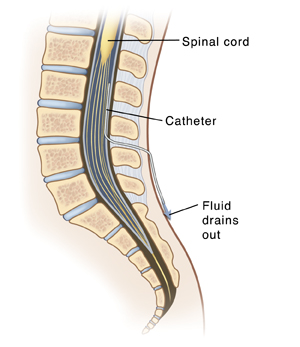
A lumbar drain is a soft, thin, sterile tube (catheter) that your healthcare provider places through the skin of your back into your lower (lumbar) spine. The drain measures pressure and collects cerebrospinal fluid (CSF). This is a clear fluid that surrounds your spinal cord and brain to protect them from injury.
During the procedure
-
You lie on your side with your knees bent toward your chest. Or you sit on the edge of the bed leaning on a support, such as a chair.
-
Your healthcare provider cleans the insertion site and injects local anesthesia into the skin around the insertion site to numb it.
-
They insert a long, thin needle between the bones (vertebrae) that make up the spine in your lower back. The needle guides the lumbar drain into place. The needle is slowly removed, leaving the drain in place.
-
The drain is covered with a bandage.
-
The drain is attached to a drainage bag and hung on an IV (intravenous) pole or placed beside you in bed. Your healthcare provider will instruct you where your drain needs to be placed. Follow your provider's instructions. It's important to keep your lumbar drain at the correct position.
While the drain is in place
-
The drain often remains in place for up to
7 days. -
A healthcare provider checks on you often while your drain is open and CSF flows into a sterile bag to be sure there are no problems.
-
While the drain is in place and open, you lie on your back or side. Let your nurse know if you’re uncomfortable and need to change positions. Your nurse can raise or lower the head of the bed.
-
If you must get up for any reason, your nurse must clamp the drain.
-
Don't touch the drain or allow visitors to touch it. This can cause an infection, change the drainage speed, or result in the drain pulling out.
-
Right after your healthcare provider inserts the drain, you may have leg pain. This pain should fade. If it gets worse or you feel numbness or tingling, let your nurse know.
Removing the drain
Your healthcare provider removes the drain slowly when you no longer need it. You lie on your side or sit bent over a support. After the drain is removed, your healthcare provider uses a stitch (suture) to close the hole. The provider places a bandage over the insertion site. The hole closes quickly, often within a few days.
When to alert a healthcare provider
Let your nurse or healthcare provider know if you have any of the following symptoms while the drain is in place, or after it is removed:
-
Stiff neck
-
Headache, especially when sitting or standing
-
Pain, swelling, or warmth at the insertion site
-
Confusion
-
Dizziness
-
Nausea or vomiting
-
Pain, numbness, or tingling in your legs that doesn’t go away
-
Trouble controlling your bladder
-
Pain that isn’t relieved by medicines
-
Leakage of clear fluid from the insertion site or tubing
-
Fever or signs of infection, such as pus coming out from where the drain was inserted
Online Medical Reviewer: Anne Fetterman RN BSN
Online Medical Reviewer: Luc Jasmin MD
Online Medical Reviewer: Raymond Kent Turley BSN MSN RN
Date Last Reviewed: 08/01/2024
© 2000-2025 The StayWell Company, LLC. All rights reserved. This information is not intended as a substitute for professional medical care. Always follow your healthcare professional's instructions.Related Articles

Discharge Instructions: Caring for Your T-Tube
You have been discharged with a T-tube, which is shaped like the letter T. It is put in place after bile duct surgery to drain bile while the duct is healing. The tube drains into a bag that is attached to your body. A bandage is present at the site where the tube is placed. This protects the open area from infection. The T-tube will be left in place for up to several weeks. Before your tube can be removed, an X-ray will be done to make sure that your duct has healed and that there are no stones present. Here's what you can do at home to aid your recovery.
Surgical Drain: When to Call Your Doctor
Learn steps to ensure your surgical drain remains healthy and in good working order. Also, learn signs of infection to be aware of and other possible reasons to contact your healthcare provider.
Discharge Instructions: Biliary Catheter
You are going home with a biliary catheter in place. This is a small, flexible tube placed into the common bile duct. It is used when this duct becomes blocked. These are some general guidelines on caring for your catheter.
Lumbar Puncture
A lumbar puncture (LP) or spinal tap may be done to diagnose or treat a condition.