Comfort and position are the keys to successful breastfeeding. Learn how to position your baby correctly at the breast. Choose the hold that works best for both of you. You may need to change holds as your baby grows.
Always make sure your baby is tummy-to-tummy with you.
If you have any questions about breastfeeding, talk with your pediatrician or lactation consultant.
“Laid-back” baby-led natural position
Lie back on a sofa, bed, or reclining chair so that your body is at a comfortable 45° angle, but not flat. This may be more comfortable than sitting up and leaning over a breastfeeding pillow.
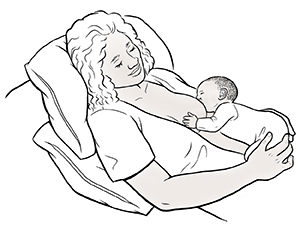
Here are some tips:
-
Place your baby on their tummy on your chest. When your baby feels your body with the whole front of their body, it sets off their senses to find your nipple. Let your baby move over to the breast and latch on without your help. Your arms will make a "nest" around your baby.
-
When your baby attaches, make sure you see more areola above the upper lip than below the lower lip. This should help protect your nipples from soreness.
Other positions you can try
Cradle hold or “cross-cradle” hold
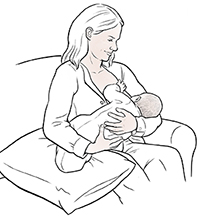
Here are some tips:
-
Sit upright. Make sure you have back support and that you are comfortable and relaxed. Raise your baby to breast height. Use a pillow under your baby’s bottom. Put your baby on their side on the pillow so their tummy is touching your tummy. Use a chair with armrests for your arms.
-
Keep your knees level with your hips. Put a stool or pillow under your feet if needed.
-
Cradle your baby. Their arm may be positioned around your body or tucked slightly under their body to keep it out of the way. Make sure your baby’s body is well supported by your arm (cradle hold). Or use your hand to support the base of your baby's head and neck (cross-cradle hold). This is a good position for a baby who has trouble latching on. You can more easily guide their head into a better position.
-
Make sure your baby’s body is facing and touching your body with your baby's head higher than their bottom. It's easier for your baby to swallow that way.
"Football" hold
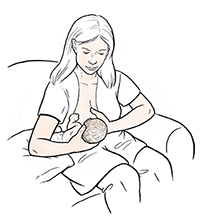
Here are some tips:
-
Place a pillow at your side. Lay the baby’s bottom on the pillow so that your baby's bottom is lower than their head. Hold your baby's neck so that your fingers are below their ears.
-
Make sure your baby's body is on their side so the whole front of your baby's body is touching yours.
-
Tuck your baby’s legs between your arm and body, as if you were clutching a football or purse at your side. Keep your baby's head level with your breast.
Side-lying hold
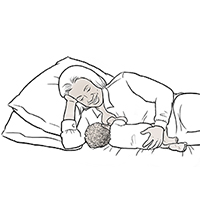
Here are some tips:
-
Stretch out on your side. Use pillows to support your head, neck, and back. Place your baby on their side facing you so the front part of your baby's body is against your body.
-
Support your baby’s head, neck, and back with your arm. Keep your baby's head level with your breast.
-
Let your baby find the nipple and attach with or without help.
-
Switch breasts. Gather your baby close to your chest. Then roll onto your other side to feed the same way from the other breast.
-
It's always possible to fall asleep while nursing, so make sure you are in a safe place when you use this hold. Do not use a couch or very soft surface. Follow your doctor's advice about a safe sleep environment for your baby.
Featured in
Online Medical Reviewer: Donna Freeborn PhD CNM FNP
Online Medical Reviewer: Heather Trevino
Online Medical Reviewer: Mary Terrell MD
Date Last Reviewed: 09/01/2025
© 2000-2026 The StayWell Company, LLC. All rights reserved. This information is not intended as a substitute for professional medical care. Always follow your healthcare professional's instructions.Related Articles

Common Breastfeeding Positions
Watch demonstrations of the three most common ways to hold your breastfeeding baby.
Breastfeeding Your Premature Infant at Home
Until now, your baby has been cared for in the NICU (neonatal intensive care unit). You’ve started breastfeeding. And you are now ready to move on to full breastfeeding at home. This sheet can answer some of your questions about making this transition.

Your Baby and Breastfeeding
Think there's only one way to breastfeed? You can position your baby in several ways during feeding time that can be comfortable for both of you.
How to Breastfeed
Your baby is born with an instinct for suckling. But it takes time for you and your baby to learn how to breastfeed. There are steps you can take to support your baby's natural instincts.