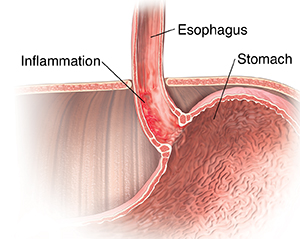
The esophagus is the swallowing tube that joins the mouth to the stomach. In people with GERD (gastroesophageal reflux disease), stomach acid flows back into the esophagus. Over many years, stomach acid can hurt the esophagus.
Barrett esophagus is when the damaged cells in the esophagus lining change to a different type of cell. These changed cells help protect the esophagus from stomach acid. But, over time, they're more likely than normal lining cells to become cancer. The acid reflux medicines used to stop heartburn do not help these cells heal or change back to normal tissue.
Radiofrequency ablation (RFA) is a procedure that uses an electrical current to kill the changed or damaged cells. It can be used to help prevent or treat cancer of the esophagus.
Why RFA for Barrett esophagus is done
RFA is most often used for people who have precancer changes in the cells lining the esophagus. It destroys the changed or abnormal cells so they can't grow into cancer. Normal lining cells then grow back to replace the damaged lining of the esophagus.
How RFA for Barrett esophagus is done
RFA is most often done as an outpatient. This means you go home the same day. During the procedure:
-
You are given medicine (anesthesia) to keep you pain-free and make you sleep during the treatment.
-
The healthcare provider puts a thin, lighted tube (called an endoscope) into your mouth. The tube is passed down your throat into your esophagus. A camera in the tube sends live video from inside your esophagus to a computer screen.
-
A balloon that holds many tiny electrodes is put through the tube. It's moved down into the area of changed cells. It's inflated so that it touches the sides of the esophagus. Then electricity is sent to the electrodes. This heats up the esophagus lining, killing the cells.
-
When the procedure is done, the provider takes out the balloon and the endoscope.
After RFA, you might be given medicines for pain and to reduce acid and coat the treated area while it heals. Your provider might talk with you about doing endoscopies every few months to watch the treated area. If needed, RFA can be repeated to be sure that all the changed cells are gone.
Risks of RFA for Barrett esophagus
Risks and side effects aren't common, but can include:
-
Chest discomfort or pain for a few days
-
Sore throat or trouble swallowing for a few days
-
Narrowing of the esophagus (stricture)
-
Irritation of or hole (perforation) in the esophagus
-
Bleeding in the treated area
-
Problems linked to the anesthesia
Author: Michels, Karen
Online Medical Reviewer: Kimberly Stump-Sutliff RN MSN AOCNS
Online Medical Reviewer: L Renee Watson MSN RN
Online Medical Reviewer: Todd Gersten MD
Date Last Reviewed: 12/01/2024
© 2000-2025 The StayWell Company, LLC. All rights reserved. This information is not intended as a substitute for professional medical care. Always follow your healthcare professional's instructions.Related Articles

Understanding Radiofrequency Ablation (RFA) of Liver Tumors
Radiofrequency ablation (RFA) is a way to treat cancer that is growing in the liver. The treatment uses heat to kill cancer cells.
Esophageal Cancer: Radiation Therapy
Radiation therapy uses high-energy radiation from X-rays or particles to kill cancer cells. Radiation is often part of the treatment for esophageal cancer. Learn why your healthcare provider may advise this treatment.
Radiofrequency Ablation (RFA) Treatment for Varicose Veins
Varicose veins are swollen, enlarged veins. They happen most often in the legs. RFA treatment uses radiofrequency to heat up the vein. This closes off blood flow to the damaged vein.
What Is Barrett Esophagus?
You have Barrett esophagus. This means that there have been changes to the lining of the esophagus near the stomach. The changes may have been caused by the acid reflux that happens with GERD. The changed lining isn't cancer. But it may raise your risk of having cancer later on.