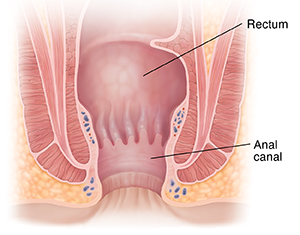
An anal stricture is a narrowing of the end of the tube (anal canal) that takes stool out of the body. It’s also known as anal stenosis. It’s caused by scar tissue in the anal canal. This can cause pain and other problems with passing stool.
What causes anal stricture?
The most common cause of anal stricture is surgery to remove hemorrhoids, warts, or a fistula. The surgery can create stiff scar tissue that causes the narrowing. Other causes include scar tissue from redness and swelling (inflammation). This can happen if you have an inflammatory bowel disease such as Crohn’s disease. It can also be caused by an infection or radiation cancer treatment in the area.
Symptoms of anal stricture
-
Pain when trying to have a bowel movement
-
Need to strain to pass stool
-
Constipation
-
Bleeding after a bowel movement
-
Thin stools
-
Need to use laxatives, suppositories, or enemas to pass stool
-
Diarrhea
-
Stool leakage
Treatment for anal stricture
-
Eating foods with more fiber. Adding more fiber-rich foods to your diet can make stools larger. Stool softeners are often added as well. In some cases, this can help on a daily basis to stretch a mild stricture.
-
Anal dilatation. This is a way to help stretch out the anal canal. For a mild stricture, this is done by placing your finger or an anal dilator into the anus, 2 times a day for 2 months. This helps to stretch the area. For a more severe stricture, dilatation may be done in a hospital. You are given medicine (general anesthesia) to let you sleep during the procedure.
-
Surgery. This is for moderate to severe stricture. There are different kinds of surgery. Small cuts (incisions) may be made in the scar tissue to help release it. Stitches are then put in place. For severe scarring, another type of surgery may be done to remove some of the scar tissue. The nearby tissue with no scarring is then held together with stitches over the area.
When to call your healthcare provider
Call your healthcare provider right away if you have any of these:
-
Pain that gets worse
-
Symptoms that don’t get better or get worse
-
Blood on your toilet tissue or in your stool
-
New symptoms
Author: Wheeler, Brooke
Online Medical Reviewer: Donna Freeborn PhD CNM FNP
Online Medical Reviewer: Jen Lehrer MD
Online Medical Reviewer: Raymond Kent Turley BSN MSN RN
Date Last Reviewed: 12/01/2022
© 2000-2025 The StayWell Company, LLC. All rights reserved. This information is not intended as a substitute for professional medical care. Always follow your healthcare professional's instructions.Related Articles

Constipation
Constipation is not being able to have bowel movements often enough. It can cause pain and other symptoms. Learn more about the causes, tests, and treatments for this common GI (gastrointestinal) problem.
Understanding Anal Fissures
An anal fissure is a small rip or tear in the lining of the anus. Learn about its causes, symptoms, and treatment.
What Is an Ileostomy?
During an ileostomy, healthcare providers either remove or disconnect your colon (large intestine), and sometimes part of the last section of your ileum (last section of your small intestine).
Understanding Hemorrhoids
Hemorrhoid tissues are "cushions" of blood vessels that swell slightly during bowel movements. Too much pressure on the anal canal can make these tissues stay enlarged and cause symptoms. This can happen both inside and outside the anal canal.