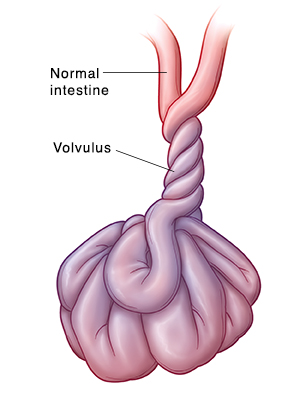
A volvulus is when the bowel (intestine) twists in a way it’s not supposed to. The twist can cut off blood flow to part of the intestine. The part of the intestine not getting blood can die. This can cause serious digestive problems. A volvulus can even be fatal. Most often, a volvulus occurs in children younger than 1 year of age.
What causes a volvulus?
Volvulus often occurs in children with intestinal malrotation. This is a problem in which the intestine twists and turns the wrong way inside the belly (abdomen). A volvulus can also be caused by infection or blockage in the intestine. In some cases, a volvulus occurs for unknown reasons.
What are the symptoms?
Symptoms of a volvulus are often sudden and severe. They can include:
-
Severe abdominal pain (a baby may cry and not be soothed)
-
Nausea or vomiting
-
Green bile in the vomit
-
Bloody stools
-
Inability to pass stool
-
Abdominal swelling or hardness (rigidity)
How is a volvulus treated?
A volvulus must be treated right away with emergency surgery. During surgery:
-
The intestine is carefully untwisted.
-
If a part of the intestine has died due to lack of blood flow, it must be removed. The healthy ends of the intestine are reattached.
-
If a long length of intestine is removed, a small opening (stoma) may need to be made in your child’s abdomen. This gives a new way for waste to leave the body. If your child needs a stoma, the healthcare provider will tell you more.
What are the long-term concerns?
If a volvulus is found and treated, your child will likely do well. But you should watch for signs of volvulus in the future. If a long portion of intestine must be removed during surgery, your child may have lifelong digestive problems, such as short bowel syndrome. Your child may also be at risk for small bowel obstruction in the future. Talk with your child’s healthcare provider for more information about your child’s outcome.
Featured in
Online Medical Reviewer: Amy Finke RN BSN
Online Medical Reviewer: Liora C Adler MD
Online Medical Reviewer: Raymond Kent Turley BSN MSN RN
Date Last Reviewed: 06/01/2022
© 2000-2025 The StayWell Company, LLC. All rights reserved. This information is not intended as a substitute for professional medical care. Always follow your healthcare professional's instructions.Related Articles

Intestinal Malrotation and Volvulus in Children
Intestinal malrotation is a birth defect. It happens when your baby’s intestinal tract doesn’t form as it should during pregnancy. Malrotation happens when your baby’s intestine doesn’t turn like it should.
When Your Child Has Intestinal Malrotation
While a baby is still in the womb, its intestines (bowels) form. As they form, they move into their normal position in the abdomen (belly). Intestinal malrotation happens when the intestines don't form in the right position. The intestines may bend the wrong way. Or, parts of the intestine may end up in the wrong part of the abdomen. Bands of tissue called Ladd bands can grow between the intestines and body wall. These secure the intestines in the wrong place. Ladd bands can also block part of the intestine, causing digestive problems.
Volvulus in infants: Fast Facts
Watch this to learn what volvulus in infants is in a brief definition that uses 3D medical animation.
When Your Child Has Intussusception
The bowel (intestine) is a very long tube. It is coiled up tightly inside the abdomen. Intussusception occurs when a portion of the bowel slides inside another portion. This happens in the same way that parts of a telescope slide inside each other when you close it. The bowel can slide back out by itself. Or, it can get stuck. Blood supply to part of the bowel could then become blocked. This can cause severe damage if not treated.