Your healthcare provider will ask about your health and sexual history. Tell your provider:
-
If you have sores
-
If you had any sores in the past
-
If any of your sex partners have had herpes
-
If any of your sex partners have had outbreaks of sores on their genitals, buttocks, or mouth
What a sore looks like
A herpes sore may first look like a small white blister. The fluid inside the blister is filled with the herpes virus. At this stage, the virus sheds easily. This means it can be passed to other people.
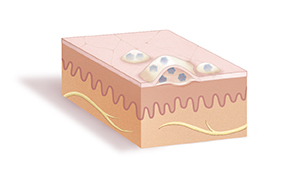
A soft wet sore may form in place of the blister. The herpes virus is in the fluid of the open sore. So the virus can still be spread to others.
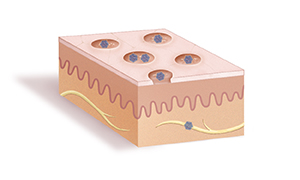
A soft crust forms as a new layer of skin grows. Fewer copies of the virus are present in the sore. The virus can still be passed to others.
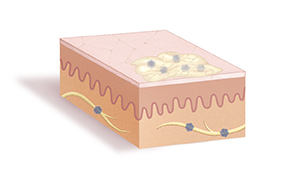
The skin surface is normal. But the virus stays in the body. Shedding is less likely. But it can still occur.
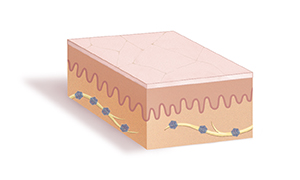
Testing for herpes
If your healthcare provider thinks you may have herpes, you may need tests done. Tests like these can confirm the diagnosis:
-
Viral culture. A small amount of fluid is swabbed from the base of a blister. The fluid is grown in a special culture with healthy cells. If herpes is present, it will change how the cells look.
-
Fluorescent antibody test. Cells are taken from the base of a blister. They are stained and checked under a microscope. If herpes is present, the cells will change color.
-
Molecular amplification. A sample of fluid that may have herpes virus is mixed with chemicals. These chemicals let pieces of the virus multiply very fast. These viral pieces can be found very quickly.
-
Other tests. If you don't have sores, tests can be done on blood or cell samples. These tests may show if you carry the herpes virus. But they are the least accurate of all the tests.
Online Medical Reviewer: Barry Zingman MD
Online Medical Reviewer: L Renee Watson MSN RN
Online Medical Reviewer: Marianne Fraser MSN RN
Date Last Reviewed: 03/01/2024
© 2000-2026 The StayWell Company, LLC. All rights reserved. This information is not intended as a substitute for professional medical care. Always follow your healthcare professional's instructions.Related Articles

Herpes Simplex Virus Culture and Typing
This test looks for which type of herpes simplex virus is causing your infection.
Herpes
If you have herpes, you're not alone. Millions of Americans have it. Herpes has no cure. But you can control it and learn how to protect yourself and others from outbreaks.
For Teens: Understanding Herpes
Herpes is a sexually transmitted disease (STD) or sexually transmitted infection (STI). It causes painful outbreaks of blisters and sores. It spreads through contact with an infected area—usually a sore on the genitals, rectum, or mouth.
Genital Herpes
Genital herpes is a common sexually transmitted infection (STI). It is caused by the herpes simplex virus. Learn more about how the virus spreads, symptoms, treatment, and how to prevent spreading it.