You’ve been told that you need imaging tests to diagnose a problem in your chest or lung. These images (scans) help the doctor find the problem and figure out if it affects other structures. You may need more than 1 imaging test. If a mass has been found, imaging tests can also help find out if it has spread. Common imaging tests are described below.
CT scan
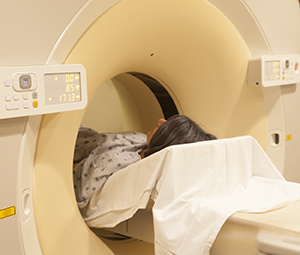
CT scans let the doctor see a more detailed picture of the chest and lungs than a regular chest X-ray. During a CT scan, many X-ray images are taken of the lungs and chest. Then a computer combines the images to create detailed images. In some cases, a special dye (contrast) is given through an IV (intravenous) line. The dye helps show parts of the body more clearly.
PET scan
Positron emission tomography (PET) is used to diagnose chest and lung problems. For a PET scan, a safe radioactive liquid (tracer) is injected into the bloodstream. It takes about 45 minutes for the tracer to be in your system. After the tracer is there, the health care provider takes a scan of your body. This helps identify abnormal cell activity. A PET scan can be helpful for finding cancer. It can also help find out if a cancer has spread. This is called staging. In some cases, you may need more testing before cancer is diagnosed or ruled out. A PET scan may be done along with a CT scan. This is called a PET-CT scan.
MRI
Like the CT scan, an MRI takes many detailed images of the chest and lungs. But an MRI does not use radiation. An MRI uses a magnetic field, computer, and radio waves to create images. Contrast dye may be given through an IV line. The health care provider then takes a scan. An MRI helps your doctor find out if a mass is affecting other structures in the chest, such as blood vessels. An MRI may take more time than other imaging tests.
Getting ready for the test
Before your imaging test, do the following:
-
Discuss all questions and concerns with your doctor.
-
Leave jewelry and other accessories at home. Or take them off before the scan.
-
Tell your doctor if you're allergic to iodine or contrast dye, or if you have kidney problems.
-
Follow any directions you're given for not eating, smoking, or drinking before the test.
-
Tell your doctor about the medicines you take. This includes over-the-counter and prescription medicines, vitamins, herbs, and other supplements. You may need to stop taking some medicines before the test. Discuss with your doctor what types of medicines to continue taking.
-
Tell your doctor about any allergies and health problems.
-
Tell your doctor and the health care provider doing the scan if you wear a medicated adhesive patch.
-
Mention if you have any metal in your body. This includes loose pieces of metal or metal devices such as an aneurysm clip, a pacemaker, a prosthesis, braces on your teeth, or an intraocular lens.
-
Tell your doctor if you're pregnant or think you may be pregnant.
-
Tell your doctor if you're breastfeeding.
During the test
For the test, you may need to wear a gown. You lie on your back inside a tube-shaped machine (scanner). You hear loud clicking sounds as images are taken. To make sure the images taken are clear, you must lie still. Straps may be used to help with this. Imaging tests (especially MRI) are done in a confined space. Talk with your doctor before the day of your test if you are afraid of confined spaces. You may be given medicine (sedation) to help you relax during the test.
Possible risks and complications
-
Swelling, infection, or other problems at the IV site
-
Contrast dye or tracer-related problems, such as allergic reactions or kidney damage
-
Damage to metal devices or prostheses from a large MRI scanner
Related Articles

Lung Surgery: Your Evaluation and Tests
You are having lung surgery. To evaluate your lungs and nearby areas, tests may be done. You may have had some of these tests. Others may be scheduled before your surgery. Your healthcare provider uses the information gathered during these tests to help plan your surgery and treatment.
Chest X-Ray
A chest X-ray is an imaging test that uses X-rays to look at the structures and organs in your chest. It can help your doctor see how well your lungs and heart are working.
Having an X-ray
An X-ray uses a small amount of radiation to create images of your bones and internal organs. X-rays are most often used to detect bone or joint problems, or to check the heart and lungs (chest X-ray).
Lung Cancer: Tests After Diagnosis
Tests help your healthcare providers learn more about your cancer. They can help show if the cancer has grown into nearby areas or spread to other parts of the body.