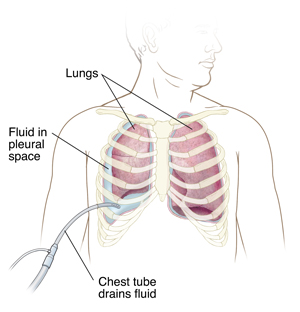
Thoracentesis is a procedure that removes extra fluid from the pleural space. This space is between the outside surface of the lungs (pleura) and the chest wall. The extra fluid is called pleural effusion. Thoracentesis may be done to take a sample of the fluid. It can then be tested to help find the cause. Or the procedure may be done to drain the extra fluid if you are having trouble breathing.
Home care
-
You may have some pain after the procedure. Your doctor may prescribe pain medicine, if needed. Take these exactly as directed.
-
If you stopped taking other medicines before the procedure, ask your doctor when you can start them again.
-
Take it easy for 48 hours after the procedure. Don't do anything active until your doctor says it’s okay.
-
Don't do strenuous activities, such as lifting, until your doctor says it’s okay.
-
Don't travel in an airplane until your doctor says it's okay to do so.
-
You will have a small bandage over the puncture site. You may remove the bandage in 24 hours, or when your doctor says it's okay.
-
Check the puncture site for the signs of infection listed below.
Follow-up
Make a follow-up appointment with your doctor as directed. During your follow-up visit, your doctor will check your healing. Be sure to let your doctor know how you are feeling.
When to contact your doctor
Contact your doctor right away if you have:
-
A fever of 100.4°F (38°C) or higher, or as directed.
-
Pain that doesn't get better after taking pain medicine.
-
Signs of infection at the puncture site. These include increased pain, redness, warmth, swelling, or fluid leaking that is green or yellow or smells bad.
-
Fluid draining from the puncture site.
-
Bleeding from the puncture site.
When to call 911
Call 911 or get care at the nearest emergency department if you have:
-
Chest pain that is unusual or suddenly gets worse.
-
Shortness of breath.
-
Coughing up blood.
Author: Accountmgr
Author: krubio
Online Medical Reviewer: Stacey Wojcik MBA BSN RN
Online Medical Reviewer: Steven Kang MD
Date Last Reviewed: 03/09/2014
© 2000-2026 The StayWell Company, LLC. All rights reserved. This information is not intended as a substitute for professional medical care. Always follow your healthcare professional's instructions.Related Articles

Thoracentesis
Thoracentesis is a procedure to remove fluid or air from around the lungs.
Discharge Instructions for Paracentesis
You have had a procedure called paracentesis to remove extra fluid from your belly (abdomen). Here's how to care for yourself at home.
Chest Tubes
Your lungs are each surrounded by two layers of membrane. The space between the layers is called the pleural space. Excess fluid, blood, pus, or air in the pleural space makes it hard for the lung to expand and makes breathing difficult. A chest tube is a soft, flexible tube put into the pleural space that drains blood, air, or excess fluid.
Having Pericardiocentesis
Pericardiocentesis is a procedure to remove fluid that has built up in the sac around the heart. Read on to learn details about what to expect before, during, and after this procedure.