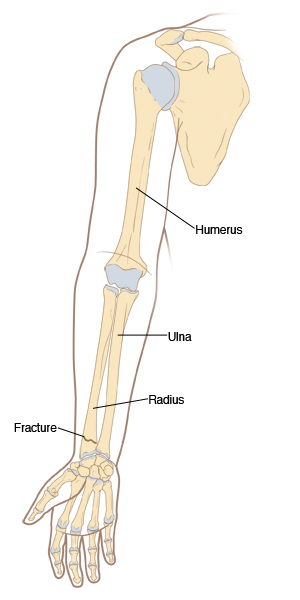
You have a break (fracture) in one or more of the bones in your arm, wrist, or hand. This may be a small crack in the bone. Or it may be a major break, with the broken parts pushed out of position. Most fractures will heal without surgery. But you may need surgery if the bones are far out of place or if the break is near the elbow. Surgery is done by an orthopedic surgeon. This is a surgeon who specializes in treating bone, muscle, joint, and tendon problems.
Nonsurgical treatment is with a special sling called a shoulder immobilizer, or a splint or cast, depending on the type of fracture and where the fracture is located. This fracture takes 4 to 6 weeks or longer to heal. The time to heal depends on several factors, such as the type of fracture, the presence of infection, your general health, and the treatment. The cast may need to be changed in 2 to 3 weeks as the swelling goes down.
Home care
Follow these guidelines when caring for yourself:
-
If you were given a shoulder immobilizer, leave it in place. This will support the injured arm at your side. This is the best position for bone healing. The shoulder immobilizer can be adjusted. If it becomes loose, adjust it so that your forearm is parallel to the ground (horizontal). Your hand should be level with your elbow.
-
Put an ice pack on the injured area. Do this for 20 minutes every 1 to 2 hours the first day for pain relief. You can make an ice pack by wrapping a plastic bag of ice cubes in a thin towel. As the ice melts, be careful that the cast/splint/sling doesn’t get wet. You can put the ice pack inside the sling and directly over the splint or cast. Continue using the ice pack 3 to 4 times a day for the next 2 days. Then use the ice pack as needed to ease pain and swelling.
-
Keep the cast, splint, or sling completely dry at all times. Bathe with your cast, splint, or sling out of the water. Protect it with a large plastic bag, rubber-banded or taped at the top end. If a fiberglass cast, splint, or sling gets wet, you can dry it with a hair dryer.
-
You may use acetaminophen or ibuprofen to control pain unless another pain medicine was prescribed. If you have chronic liver or kidney disease, talk with your health care provider before using these medicines. Also, talk with your provider if you’ve had a stomach ulcer or gastrointestinal bleeding.
-
Don’t put creams or objects under the cast if you have itching. You may use a hair dryer on a cool setting and aim it under the cast to relieve itching. Don't use a warm or hot setting, as this can burn your skin. If this does not help, ask your provider about medicines to relieve itching.
Follow-up care
Follow up with your health care provider as advised. This is to make sure the bone is healing the way it should.
X-rays may be taken. You will be told of any new findings that may affect your care.
When to get medical advice
Contact your health care provider right away if:
-
The cast or splint cracks.
-
The cast or splint becomes wet or soft.
-
The cast or splint stays wet for more than 24 hours.
-
The cast has a bad smell, or wound fluid stains the cast.
-
Tightness or pain under the cast or splint gets worse.
-
Your fingers become swollen, cold, blue, numb, or tingly.
-
You can’t move your fingers.
-
Your skin near the cast or splint becomes red or irritated.
-
You have a fever of 100.4ºF (38ºC) or higher, or as advised by your provider.
-
You have chills.
Online Medical Reviewer: Marianne Fraser MSN RN
Online Medical Reviewer: Raymond Turley Jr PA-C
Online Medical Reviewer: Shaziya Allarakha MD
Date Last Reviewed: 01/01/2025
© 2000-2025 The StayWell Company, LLC. All rights reserved. This information is not intended as a substitute for professional medical care. Always follow your healthcare professional's instructions.Related Articles

Upper Extremity Fracture (Child)
Your child has a broken bone or fracture in the upper extremity. The upper extremity includes the shoulder, arm, wrist, or hand. Learn how to care for your child as they heal.
Elbow Fracture
You have a break (fracture) of 1 or more bones of the elbow joint. This may be a small crack in the bone. Or it may be a major break, with the broken parts pushed out of position. Learn how to care for yourself at home as you heal.
Open Finger Fracture
You have a broken finger (fracture) with a nearby cut, puncture, or deep scrape. This causes local pain, swelling, and bruising. Because of the open injury, you are at risk for infection in the skin and bone. You will take antibiotics to lower the risk for infection.
Open Hand Fracture (Adult)
You have a fracture, or broken bone, in your hand. An open fracture means that the bone goes through the skin. Or it may mean there is a wound in the skin that goes as deep as the fractured bone. Because of this, there is a risk of infection to the skin or bone. Here's how to care for the fracture as it heals.