Right Heart Catheterization: Before Your Procedure
What is right heart catheterization?
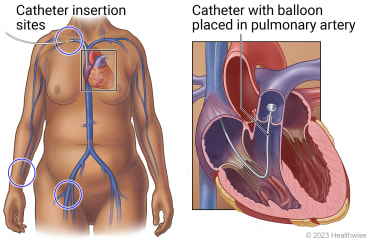
The right side of the heart receives blood from the body and pumps
it to the lungs. The blood picks up oxygen in the lungs. A right
heart catheterization (also called pulmonary artery catheterization)
tests the blood pressure and oxygen levels in your lungs and heart.
It also checks to see how well your heart is pumping.
Your doctor will put a thin, flexible tube (catheter) into a blood
vessel in your neck, groin, or arm. During the test, the doctor will
move the catheter through the blood vessel into your heart. If your
doctor uses an X-ray to see where to move the catheter, you will
also get dye injected into your blood vessel and heart. When the
catheter is in your heart, the doctor will inflate a small balloon
on the tip of the catheter. This helps guide the catheter into the
artery that carries blood to your lungs (pulmonary artery).
The test usually takes about 1 to 1½ hours. You may have swelling,
bruising, or a small lump around the site where the catheter went
into your body. You can do light activities around the house. But do
not do anything strenuous until your doctor says it is okay. This
lets the catheter site heal.
How do you prepare for the procedure?
Procedures can be stressful. This information will help you
understand what you can expect. And it will help you safely prepare
for your procedure.

Preparing for the procedure
|
|
|
|
|
|
|
|
|
|
|
|
|
|
|
What happens on the day of the procedure?
|
|
|
|
|
|
|
|
|
|
|
|

At the hospital
or surgery center
|
|
|
|
|
|
|
|
|
|
|
|
|
|
|
|
|
|
|
|
|
When should you call your doctor?
|
|
|
|
|
|
|
|
|
|
|
|

Current as of: June 24, 2023
Content Version: 14.0
Care instructions adapted under license by your healthcare
professional. If you have questions about a medical condition or
this instruction, always ask your healthcare professional.
Healthwise, Incorporated disclaims any warranty or liability for
your use of this information.
Related Articles

Cardiac Catheterization: Right
What is it?Right heart catheterization is a test to check the right side of your heart. The right side of...
Right Heart Catheterization: Pulmonary Artery Catheterization: Post-op
Right Heart Catheterization: What to Expect at Home Your Recovery The right side of ...
Cardiac Catheterization: Left
What is it?Left heart catheterization is a test to check the left side of your heart. Your doctor might c...
Cardiac Catheterization
In cardiac catheterization (often called cardiac cath), a very small hollow tube, or catheter, is advanced from a blood vessel in the groin, arm, or neck through the aorta into the heart. Once it is in place, several diagnostic and treatment procedures can be done using catheterization.